
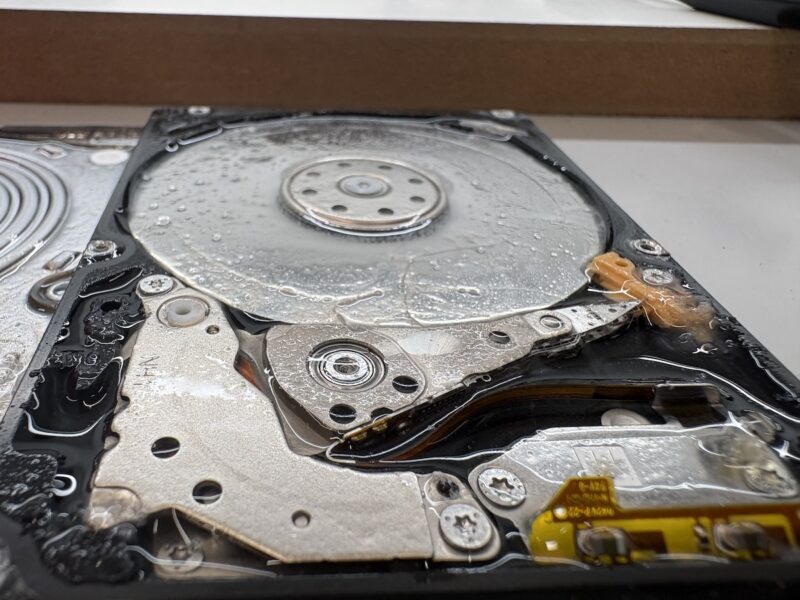
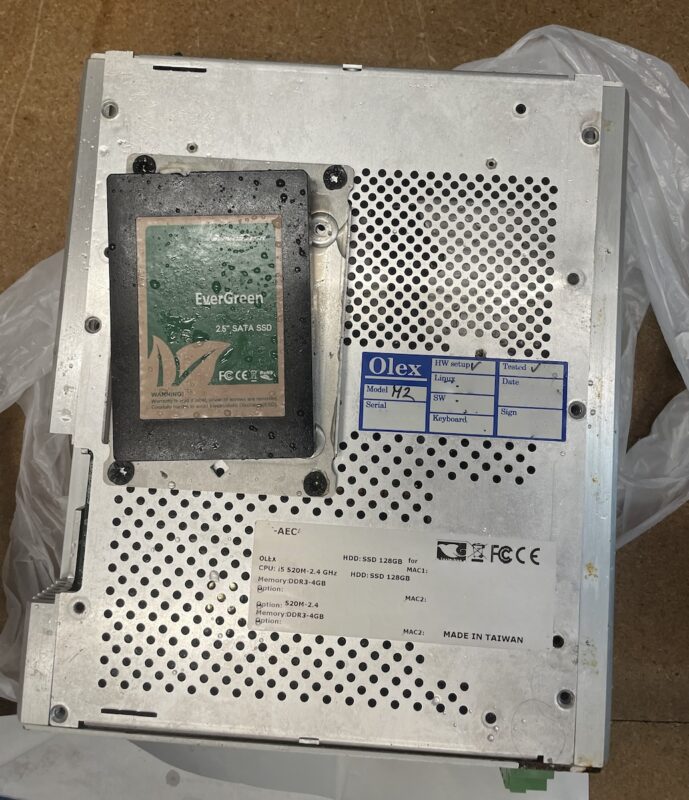
We recently heard from a local fisherman that had been unfortunate to have his boat take on water whilst moored during a storm. Due to a series of unfortunate events, the only record of his fishing pots out at sea were stored on the ship computers. These computers were not only submerged in seawater, but also diesel from the engines.
Our first step was to carefully extract the storage drives from the computers. One contained a 128GB InnoDisk EverGreen SSD, and the other a Toshiba Hard Drive.
We decontaminated the surfaces of the drives, to make them easier to deal with. We don’t often have diesel soaked disks in our workshop.
A Warning ⚠️
It is important with any liquid damage to make sure there is nothing still wet before you apply power.
The SSD
We removed the SSD circuit board from its shell, and found that water and diesel were present inside. Using a combination of chemical cleaners and delicate pads and brushes, we cleaned the board, and then let it dry thoroughly.
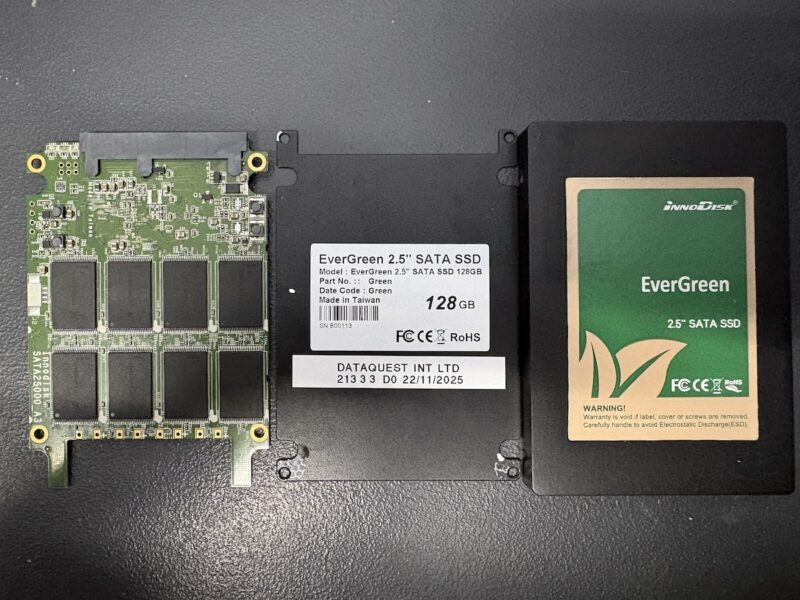
Once dry, we checked for short circuits, and found that the device wasn’t shorted. We applied power, but the SSD failed to reach a ready state. Although the main power rail wasn’t shorted, there must have been a problem further downstream. We found an area of the board that was getting no power, and found a damaged SMD resistor nearby. Replacing that got the drive correctly identified, and we were able to make a full clone copy of the disk.
Once the clone was complete, we were able to recover the files containing the fishing data, and send to the customer to have reloaded onto a replacement unit.
So far, so good.
The HDD
Some of the screws on the circuit board were a bit corroded, but the board itself looked in a reasonable state. Most boards can be adapted using the ROM chip, so rather than attempt to repair the board, we saved the ROM chip contents, and wrote it to a matched board.
As with the SSD, it was important to make sure no water had got into the delicate parts of the drive. People assume that hard drives are sealed, but almost1 all disks have a small breather hole, to allow for the pressure inside to equalise during normal use. We’ve seen many water damaged disks where no water managed to get through the hole, but this was not one of them. Inside this drive was full of thick, almost jelly like liquid.

We didn’t hold out much hope, especially as there seemed to be concentric rings on the disk surface, which usually indicate scratches from the heads. Fortunately after a thorough clean, we noticed that the rings were caused by the shape of the top cover. Not damage, just rings of sediment / dirt.
We removed and cleaned the disc, and then placed it into a donor casting. The only original part of the hard drive was the single glass disk, and the ROM contents.
With a bit of manipulation on the data recovery kit, the drive showed up and allowed us to load the filesystem to see the files and folders. When working in this way, all sectors we read are simultaneously saved to another disk. This allows us to build up a copy of the disk over multiple passes, without having to read the same parts over and over again (the next time we request the same sector, it comes from our copy instead of the failing disk). It’s how we always work, but really makes sense with disks like this in such terrible condition.
After four sets of new heads, we finally had the fishing data recovered from the disk. Looking back at the photos, it’s hard to believe that any recovery was possible in this case.
Luckily, the data required from this sort of thing is usually small lists of numbers, coordinates etc, so can be possible to read even if the drive is in a bad state.

Footnotes
- Helium filled disks do not have a breather hole. ↩︎
Leave a Reply